
Deepening Student Engagement by Expanding Voice, Choice, and Meaningful Challenge

This article is part of the series, “Designing Middle Schools for a New Generation: What Central Office Leaders Need to Know,” which shares what central office leaders need to know to build on the strengths of the traditional middle school model to rethink how schools can better support a new generation of young adolescents. Across five posts, we share actionable, research-backed, system-level strategies school and district leaders can implement, strengthening core instruction, broadening opportunities for students, and using time and resources more strategically to boost learning and engagement over the long term.
Districts widely recognize that student engagement in the middle school years matters deeply. Disengagement during this period can lead to absenteeism and behavior challenges, among other challenges. At the same time, middle schools operate within real constraints, including long-standing staffing models, jammed-packed schedules, and downstream expectations from high school, all of which can make finding opportunities for meaningful engagement difficult.
So, what can be done? Middle schools that are most successful at engaging students are finding ways to create opportunities for voice, choice, and accelerated class options within the existing structure of the school day.
Engagement in Middle School Is Closely Tied to Agency and Relevance
Research consistently shows that middle schools offering students some degree of agency—particularly through enriching exploratory and elective classes aligned to student interests—see higher levels of student engagement than those that do not. Middle school is a formative time both academically and personally, and it follows that students are more likely to engage deeply in learning experiences that feel relevant and connected to their interests.
Most middle schools offer standard exploratory classes to students, such as art, physical education, and world language—important subjects, without question. However, offering only these options is rarely enough to fully tap into the range of interests students bring with them. Schools that are seeing stronger engagement are building on this foundation by expanding the variety of offerings, recognizing that student interests today are broader and more varied.
The goal is not to offer unlimited choice, but opportunities that are meaningful and manageable.
Student Voice: Engagement Through Input on Course Offerings
One of the implied purposes of non-core classes, which account for 30-40% of every student’s day, is to build interest in and connection to school. Yet in many places, these offerings have changed little over time and may no longer reflect student interests and passions.
Updating non-core offerings can take many forms: introducing new versions of familiar courses, incorporating modern trends and technology, or developing core-adjacent spinoffs such as Podcasting 101 or Fantasy Sports Math. These approaches can reinvigorate exploratory programming while remaining feasible within existing structures.
To deepen engagement further, schools can invite student input. Schools that successfully incorporate student voice often use a two-step approach: first, students share broad areas of interest or curiosity via survey; then, schools share a curated list of potential course ideas and ask students to rank their preferences. This approach provides useful data while keeping decisions grounded in what is feasible—and it signals to students that their perspectives are valued, even when not every idea can be pursued.
Student Choice: Engagement Through Course Selection
While student voice helps shape what courses are offered, choice allows students to select from the available options. Even with thoughtful incorporation of student voice, no single set of offerings will appeal to every student.
At the middle school level, bounded choice and scaled choice offer practical “middle-ground” approaches that expand student agency while accounting for scheduling and staffing realities. These models make choice sustainable rather than overwhelming.
Bounded choice allows students to experience a common set of disciplines, but while still having autonomy. For example, students might be required to take one art, one music, and one physical education course each year, with multiple options available within some or all categories.
Scaled choice is another common approach where students rotate through a required set of exploratory courses in lower middle school grades before gaining greater choice and agency in upper grades.
Importantly, many schools are able to expand choice without adding staff, extending the school day, or reducing time for core instruction. Common strategies include:
Aligning electives with teacher interests and expertise
Phasing in new offerings gradually
Managing staffing adjustments through attrition rather than abrupt, enrollment-driven shifts
Shifting the duration or frequency of classes, such as running an elective class for a semester instead of a full year
Engagement Also Comes from Appropriate Academic Challenge
For some students, engagement is driven less by choice of topic and more by the opportunity to be challenged academically via honors and accelerated classes in core subjects.
In some districts, particularly in math and English, these courses have been eliminated on the premise that if access cannot be universal, they should not exist at all. In other cases, such options were never offered. Meanwhile, in more affluent communities, families often seek outside providers, such as Russian Math or Mathnasium, to secure advanced opportunities.
The paradox is clear: in the name of equity, schools can unintentionally create systems where only families with resources can access acceleration. To support sustained engagement, middle schools can provide honors and advanced options with multiple entry and exit points, ensuring students are neither locked in nor excluded based on early or one-time decisions. Expert scheduling can help schools that offer honors classes in some subjects avoid strictly cohorting students, which can lead to what some call “honors PE” or “accelerated lunch.”
Why This Matters—and the Role of Central Office Leaders
Student engagement is closely linked to attendance, persistence, and long-term success. When students experience agency and appropriate challenge, they are more likely to feel connected to school and invested in their learning—benefiting both students and the educators who support them.
District and central office leaders play an essential role in enabling engagement-focused middle school design by creating conditions that allow schools to thoughtfully expand voice, choice, and honors classes. This includes encouraging reflection on how exploratory time is currently structured, supporting scheduling approaches that balance core instructional priorities with meaningful choice, and providing guidance on flexible, inclusive approaches to honors and acceleration.
Boosting engagement in middle school does not require abandoning what already works; it requires building thoughtfully on existing structures so they continue to meet the evolving needs of young adolescents. When voice, choice, and meaningful honors options are intentionally designed into the middle school experience, engagement becomes less about motivating students and more about creating the conditions in which motivation naturally grows.
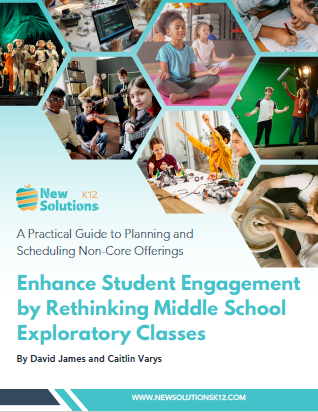
LEARN MOREEnhance Student Engagement by Rethinking Middle School Exploratory Classes
A Practical Guide to Planning and Scheduling
Non-Core Offerings
This article is part of the series, “Designing Middle Schools for a New Generation: What Central Office Leaders Need to Know,” which shares what central office leaders need to know to build on the strengths of the traditional middle school model to rethink how schools can better support a new generation of young adolescents.
Check out the other posts in the series here:
The Case for Reimagining Middle School—And Why Core Instruction Must Come First
Why Many Middle Schoolers Aren’t Catching Up—And What Actually Works
Boosting Student Emotional Well-Being by Rethinking and Reducing Unstructured Time
Strengthening Middle Schools by Cost-Effectively Rethinking Teaming and Staffing
About the Author
David James is a former teacher and middle school administrator who serves as an advisor to school and district leaders. He and his team have helped more than 100 middle schools across the nation better serve a new generation of students and educators. He is co-author of the book, It's Time for Strategic Scheduling: How to Design Smarter K-12 Schedules That Are Great for Students, Staff, and the Budget. He also leads the Secondary Scheduling Academy, an accelerated hands-on training program for school and district leadership teams to enhance capacity for strategic scheduling, build buy-in for changes, and design effective, best practice-aligned schedules that are better for students, teachers, and the budget.